Gabriel Oak’s sheep flock
Far from the Madding CrowdGabriel Oak’s sheep flock sustains his bid to rise from shepherd and bailiff to farmer in his own right, but its value is never merely financial: the animals depend on his intimate knowledge, and their welfare can outweigh calculation even after catastrophe. The flock’s story moves from lambing care on Norcombe Hill, through a disastrous fall into a chalk-pit and a rescue from clover-induced bloat, to the recurring labor of shearing and the reading of weather. Its changing condition measures both the precariousness of rural independence and Oak’s persistent responsibility toward living creatures.
The flock and Oak’s farming venture
During the year before the lambing season described, Gabriel Oak leased a small sheep farm that included part of Norcombe Hill and stocked it with two hundred sheep. He had worked first as a shepherd beside his father, then briefly as a bailiff; becoming a farmer rather than a hired man was a substantial step, made possible by industry and sustained good spirits. The flock had been bought on credit, with a dealer receiving a percentage until the advance was paid off, so the animals represented both a productive asset and a liability that Oak could not afford to lose.
At lambing, Oak chose not to delegate the work to a hireling or novice. He brought the ewes into a part of the slope he had marked out with detached straw-thatched hurdles, and tended them himself through the night. From the shepherd’s hut, with its lantern, stove, milk warming in a can, and simple veterinary supplies, he went out among the flock and returned carrying a newly born lamb. After warming it on hay, he took it back into the darkness and placed it with its mother. The scene establishes a practical intimacy: the shepherd’s knowledge is learned through labor, and the animals’ survival rests on his attendance rather than on abstract ownership.
Catastrophe at the chalk-pit
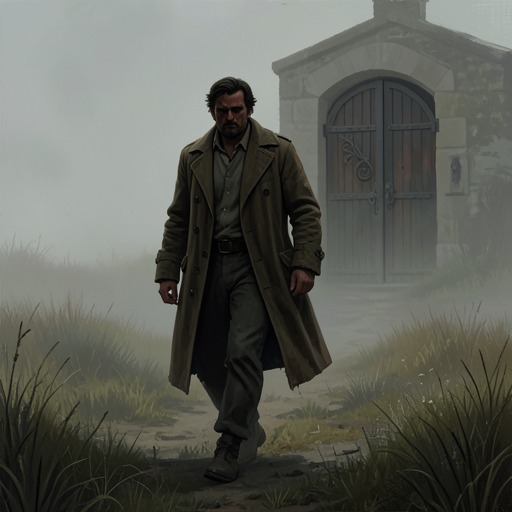
That dependence becomes stark when Oak’s young sheepdog drives the flock over a precipice. The dog had been left on the hill with old George after eating a dead lamb. Before dawn, Oak heard the sheep-bell ringing with the rapid, regular pulse that his experienced ear recognized as a flock running at speed. He hurried up the hill and found that two hundred ewes, the bulk of his flock, had vanished. Their tracks led through a gap in a hedge toward the chalk-pit, where he saw the younger dog standing by a broken railing.
At the foot of the pit lay two hundred mangled carcasses, with the unborn lambs adding to the scale of the loss. Oak’s first response was pity for the ewes and their young; only afterward did he take in what their deaths meant for his own prospects. The flock was uninsured, and its destruction wiped out the savings he had put into the farm. Oak had to face the collapse of his hope of independence, though an accounting of the stock, plant, and implements he still owned showed that their value would cover his debts and leave him free, if impoverished. His immediate gratitude that he was not married underscores how suddenly this agricultural failure becomes a question of responsibility to another person as well as of livelihood.
The disaster also exposes the difference between an animal’s purpose and the judgment of the inexperienced dog. The dog appears to have understood its work as pursuing sheep as vigorously as possible; it drove the flock through the broken fence and worried the ewes until they broke the rotten railing. Its consistent obedience to a crude principle produces a ruin no one intended. The dog was shot later that day, while Oak was left to bear the financial and emotional consequences. The episode refuses to make the sheep’s deaths a simple misfortune of bookkeeping: the animals are described as defenseless, and Oak’s grief begins in recognition of their suffering.
Recovery and renewed dependence
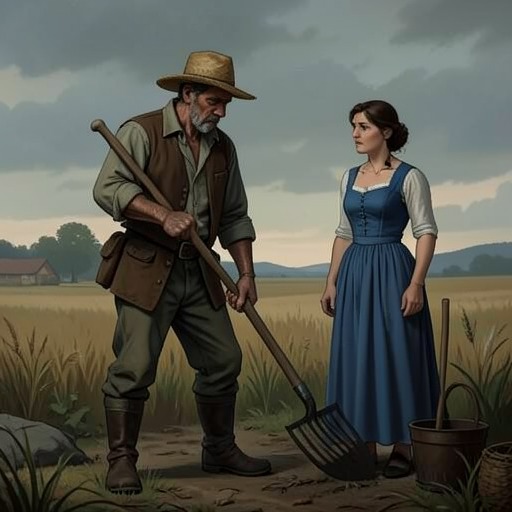
The surviving flock later faces another emergency when fifty-seven sheep stray and become dangerously bloated after feeding on clover. Bathsheba Everdene, unable to bring them round, sends urgently for Oak and adds a personal plea not to be deserted. Oak responds without delay. He removes his coat, rolls up his sleeves, and uses a trocar to puncture each animal at the proper point, releasing the trapped air. His skill turns shepherding knowledge into immediate veterinary intervention: forty-nine operations succeed, four sheep have already died, and three recover without an operation. In one case, Oak misses his aim and mortally wounds a ewe, a painful exception that makes the work’s stakes plain rather than effortless.
Once the crisis has passed, Bathsheba asks Oak to stay on with her, and he agrees. The rescue therefore changes the human arrangement as well as the flock’s condition. The animals’ emergency brings Oak back into Bathsheba’s service after their rupture, while his willingness to help shows that his attachment to her and his practical care for the farm remain entangled. The flock is not simply a backdrop to their relationship: its needs create the occasion for a consequential decision and make useful labor the form Oak’s devotion takes.
Seasonal labor and shared farm life
The surviving sheep recur within the farm’s seasonal work. On the first of June, during shearing at the Weatherbury Great Barn, Oak serves as general supervisor while the shearers work in a central threshing-floor enclosed by pens of sheep. Bathsheba watches closely to prevent careless cuts and to ensure that the animals are shorn close. Oak selects sheep for the workers, distributes bread, cheese, and mild liquor, and shears one ewe with such speed and control that Bathsheba times the work at twenty-three and a half minutes. Her scrutiny is directed both at efficiency and at the animals’ treatment; his skill earns her praise, and the scene places competent care inside the ordinary rhythms of production.
The shearing also marks the flock as part of an enduring rural order. The barn’s old structure and the repeated work of the shearers belong to a countryside where seasonal practice changes slowly, even as individual fortunes shift. Sheep are gathered, restrained, shorn, and released; their wool is collected and tied, making the flock a source of material and income. Yet the narrative keeps the animals’ bodily vulnerability visible in the frightened sheep held for shearing and in Bathsheba’s concern that no one wound them. Their place in the economy does not cancel the obligations of care.
Weather, animal knowledge, and narrative significance
Oak’s attention to animals extends beyond direct treatment to the signs their behavior offers. Before a threatening storm, he first notices a large toad crossing the path and a garden slug leaving a shining trail indoors. More decisively, he checks the flock: the sheep are huddled close together, do not scatter when his head appears over the fence, and have turned their tails toward the quarter from which the storm threatens. He reads their formation as evidence of the coming thunderstorm, while the other creatures suggest cold, persistent rain afterward. Their different responses help him anticipate a complicated change in weather and recognize the danger to the farm’s exposed harvest.
This attentive reading connects animal life to the novel’s agricultural causality. The flock signals danger, but it is not made infallible or reduced to an emblem: the sheep’s behavior is useful because Oak knows it through years of observation. At the same time, the sheep themselves remain vulnerable to forces and decisions they cannot control—the storm, the conditions of their pasture, the novice dog’s overzealous herding, and the human systems that value them as stock. Their narrative significance lies in that tension. They are wealth on which Oak’s independence depends, working bodies in a seasonal economy, and living creatures whose suffering commands his compassion even when their loss threatens his future.